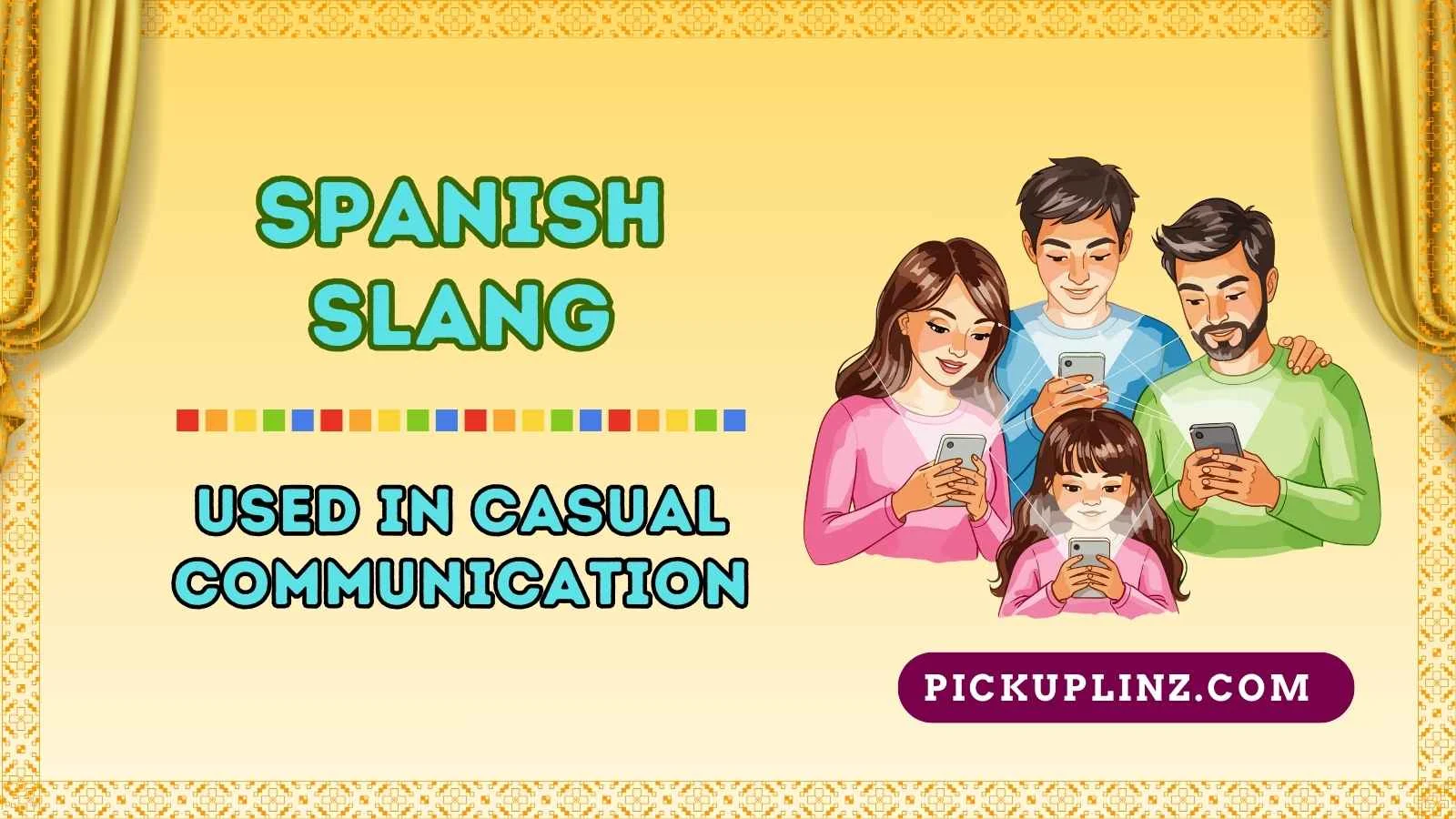
Spanish slang refers to informal expressions, words, and phrases that native speakers use in everyday conversation instead of formal or academic Spanish. People search for Spanish slang because traditional textbooks often fail to teach how Spanish is actually spoken in daily life on WhatsApp, Instagram, TikTok, dating apps, movies, music, and street conversations.
Slang adds emotion, humor, personality, and identity to the language. It reflects social class, age, region, and cultural background. A single slang word can express excitement, anger, affection, sarcasm, or flirtation depending on context and tone.
Understanding Spanish slang helps:
- Learners sound more natural and confident
- Travelers avoid misunderstandings
- Professionals understand informal communication
- Online users connect authentically
Spanish slang is constantly evolving, shaped by youth culture, technology, music, migration, and social media trends.
Meaning & Definition of Spanish Slang
Spanish slang consists of non-standard vocabulary used in casual communication. These words may:
- Change meaning over time
- Differ by country or region
- Carry emotional or cultural nuance
- Sound strange when translated literally
Key Characteristics of Spanish Slang
- Informal and conversational
- Often not found in dictionaries
- Frequently used by younger generations
- Influenced by pop culture and technology
- Context-dependent
Example
| Standard Spanish | Slang Version | Meaning |
|---|---|---|
| Amigo | Tío / Bro | Friend |
| Muy bueno | Brutal | Amazing |
| Trabajo | Curro | Job |
| Dinero | Lana / Plata | Money |
Slang is not incorrect Spanish — it’s simply Spanish used in its most human form.
Background and Historical Evolution of Spanish Slang
Spanish slang didn’t appear overnight. Its evolution mirrors the history of Spanish-speaking societies.
Historical Influences
- Latin roots mixed with local dialects
- Indigenous languages in Latin America
- Arabic influence in Spain
- African linguistic patterns in the Caribbean
- Immigration and globalization
Modern Influences
- Reggaeton, hip-hop, and Latin pop
- TV shows and movies
- Internet culture and memes
- Urban youth movements
Slang spreads faster today due to social media, where a word from Argentina can trend in Spain within days.
Spanish Slang Usage in Different Contexts
Spanish slang adapts depending on where and how it’s used.
Casual Conversations
Used among friends, family, and peers to sound relaxed and expressive.
Professional Environments
Generally avoided unless:
- Workplace culture is informal
- Creative industries (marketing, media, tech)
- Internal team communication
Online Communication
Slang dominates chats, comments, captions, and DMs.
Rule of Thumb
If the situation is formal, avoid slang. If it’s social, slang is welcome.
Spanish Slang in Chat, WhatsApp, Instagram, and TikTok
Digital communication has transformed Spanish slang.
Common Chat Slang Examples
| Slang | Meaning | Context |
|---|---|---|
| Jaja | Haha | Laughter |
| Vale | Okay | Agreement |
| Qué fuerte | No way | Shock |
| WTF | Shock | Internet slang |
| XD | Laughing | Emojis + text |
Instagram & TikTok Trends
- Shortened words
- Phonetic spelling
- Meme-based phrases
- Hashtag slang
Key Insight
Tone matters. A word can be:
- Friendly
- Flirty
- Sarcastic
- Offensive
Spanish Slang Meaning in Physics, Medical, and Aircraft Fields
Spanish slang has no formal role in scientific or technical fields.
Why Slang Is Avoided
- Precision is critical
- Technical terms must be universal
- Slang creates ambiguity
Example
| Field | Language Used |
|---|---|
| Physics | Standard scientific Spanish |
| Medicine | Formal medical terminology |
| Aviation | International technical language |
However, professionals may use slang casually off-duty, never in official documentation.
Common Misconceptions About Spanish Slang
Misconception 1: Slang Is Incorrect Spanish
❌ False
Slang is a natural evolution of language.
Misconception 2: Slang Is Universal
❌ False
A word in Mexico may mean something offensive in Spain.
Misconception 3: Only Young People Use Slang
❌ False
Every generation has its own slang.
Similar Terms and Alternatives to Spanish Slang
Related Language Types
- Colloquial Spanish – casual but widely accepted
- Idioms – fixed expressions
- Regionalisms – location-specific terms
When to Use Alternatives
- Formal writing
- Professional emails
- Academic settings
Neutral Spanish ensures clarity when slang may confuse.
How to Respond to Spanish Slang Naturally
Best Practices
- Match the speaker’s tone
- Avoid overusing unfamiliar slang
- Ask politely if unsure
Safe Responses
- Neutral Spanish
- Emojis
- Simple acknowledgments
Example
No entendí eso, ¿qué significa?
(I didn’t understand that, what does it mean?)
Differences Between Spanish Slang and Similar Words
| Feature | Slang | Idioms | Colloquial |
|---|---|---|---|
| Flexibility | High | Fixed | Medium |
| Formality | Very informal | Informal | Semi-informal |
| Change rate | Fast | Slow | Moderate |
Slang evolves the fastest and reflects current culture.
Spanish Slang in Online Conversations and Dating Apps
Spanish slang plays a huge role in online flirting and dating.
Why Slang Matters
- Shows cultural awareness
- Feels relaxed and authentic
- Builds emotional connection
Dating App Usage
- Playful teasing
- Compliments
- Ice-breakers
Warning
Using slang incorrectly can:
- Sound forced
- Create misunderstandings
- Reduce credibility
Case Study: How Spanish Slang Builds Connection
Scenario:
Two users chatting on a dating app.
Without Slang
Hola, ¿cómo estás?
With Slang
Hey, ¿qué tal todo? 😄
Result:
The second feels warmer, more natural, and engaging.
Famous Spanish Slang Across Regions
| Country | Popular Slang | Meaning |
|---|---|---|
| Spain | Guay | Cool |
| Mexico | Chido | Awesome |
| Argentina | Boludo | Dude |
| Colombia | Parcero | Friend |
| Puerto Rico | Brutal | Amazing |
Why Spanish Slang Keeps Evolving
Main Drivers
- Youth creativity
- Social media trends
- Music and entertainment
- Global interaction
Language is alive — slang proves it.
FAQs:
What is Spanish slang in simple words?
Spanish slang is informal language used in daily conversations instead of formal Spanish.
Is Spanish slang the same in all countries?
No, slang varies widely by country and region.
Can Spanish slang be offensive?
Yes, some words can be offensive depending on context and location.
Should learners use Spanish slang?
Yes, but carefully and gradually.
Is slang acceptable in professional Spanish?
Only in very informal or creative environments.
Conclusion: Why Spanish Slang Truly Matters
Spanish slang is not just language decoration it’s cultural expression in motion. It reflects humor, emotions, identity, and modern life across Spanish-speaking communities.
Learning Spanish slang helps you sound more natural, understand real conversations, and connect authentically in both offline and online interactions.
Whether you’re chatting with friends, scrolling social media, or navigating dating apps, understanding Spanish slang gives you confidence and cultural awareness.
Use it thoughtfully, respect regional differences, and remember that slang is about connection, not perfection.

Hi, I’m Ben Mark, the creator behind Pickuplinz.com.
I’ve always believed words have power especially the kind that make people smile, blush, or laugh out loud. That’s what inspired me to build Pickuplinz, a place where fun, charm, and creativity come together through clever pickup lines and playful word magic.
I enjoy turning simple phrases into something memorable. Whether it’s smooth, funny, cheesy, or bold, my goal is to help people break the ice, spark conversations, and add a little confidence to their social game.
When I’m not working on new content, I’m exploring trends, humor styles, and creative ways people connect through words online.
Thanks for being here let’s keep the vibes fun and the lines smooth.